Glock 34 vs Glock 17L: Which Long Slide Suits Your Match
Two Glocks have carried the long-slide name for competition shooters: the G17L, which arrived in the late 1980s, and the G34, which came later and became the default match gun for a generation of action pistol shooters. They look similar on a table and they are not interchangeable. The G17L is longer, older and sold in one configuration; the G34 is shorter, current, and available as a Gen5 MOS with a factory optic cut. This page puts the published measurements next to each other and explains what the difference actually does on a stage. What we currently hold is under long-slide pistols.
The measurements, side by side
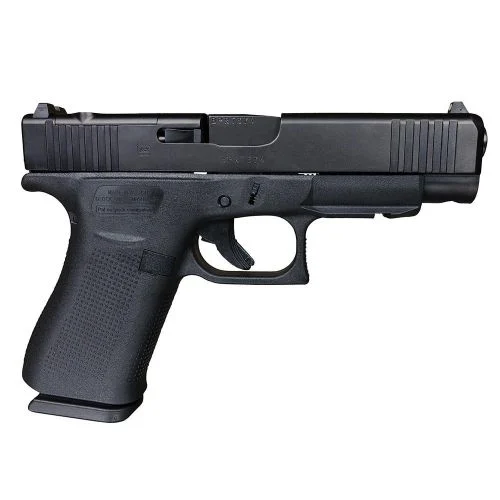
Glock publishes both pistols in its own specification tables. The G34 Gen5 MOS is chambered in 9x19 with a 5.31-inch (135 mm) barrel, an 8.15-inch (207 mm) slide and an 8.74-inch (222 mm) overall length. Polymer-sight radius is 7.52 inches (191 mm). It stands 5.47 inches tall with a magazine in, measures 1.34 inches at its widest point, and weighs 23.46 ounces bare or 26.21 ounces with an empty magazine. Trigger distance is 2.76 inches. The standard magazine holds 17 rounds, with 10-round and 24-round options listed.
The G17L uses the same 9x19 chambering but stretches further. Barrel length is 6.02 inches (153 mm), the slide is 8.86 inches (225 mm) and overall length is 9.53 inches (242 mm). Polymer-sight radius is 8.07 inches (205 mm). It is fractionally narrower at 1.30 inches, the same 5.47 inches tall, and weighs 23.81 ounces bare or 26.63 ounces with an empty magazine. Trigger distance is 2.83 inches, and the standard magazine is the same 17-round tube.
- Barrel: G34 5.31 in, G17L 6.02 in, a difference of 0.71 inches.
- Sight radius: G34 7.52 in, G17L 8.07 in, so 0.55 inches more on the G17L.
- Overall length: G34 8.74 in, G17L 9.53 in.
- Weight with an empty magazine: G34 26.21 oz, G17L 26.63 oz.
- Magazines: both take standard 17-round 9 mm Glock tubes.
What the extra half inch of sight radius buys
Sight radius is the distance between front and rear sight. A longer one means a given angular error at the sights moves the bullet less at the target, so irons are easier to align precisely. That is the classic argument for the G17L and it is real, but it matters most with notch-and-post sights. If you are shooting a red dot the argument mostly evaporates, because a dot gives one aiming reference rather than two and lengthening the slide does nothing to sharpen it.
The longer barrel does two other things. It adds a small amount of muzzle velocity, which matters if you are loading close to a 125 power factor floor and want margin at the chronograph stage. And it moves mass forward, which changes how the pistol tracks in recoil. Some shooters find the G17L flatter; others find it slower between targets because the extra weight sits at the end of a longer lever. Neither reaction is wrong. Handle both before you commit.
Optics: the G34 has the factory answer
The G34 Gen5 MOS ships with a milled optic cut and a set of adapter plates, so a red dot bolts to the slide without gunsmithing. That is the biggest practical difference between the two pistols today, because USPSA Carry Optics requires an optic mounted directly to the slide between the rear of the slide and the ejection port, and frame-mounted optics are not allowed in that division.
The G17L has no factory optic cut. Putting a dot on one means sending the slide out to be milled or buying an aftermarket slide, and either route costs money and time. Footprints matter too: an RMR-pattern plate takes the Trijicon RMR and SRO and the Holosun 407C, 507C and 508T family, while a Leupold DeltaPoint Pro and an Aimpoint ACRO each want their own plate. Our Carry Optics guide goes through footprints and mounting, and the MOS plates and optics we list are in the catalog.
Which divisions each one fits
USPSA Carry Optics wants an optic on the slide, caps the pistol at 59 ounces with the optic and an empty magazine inserted, bars compensators and barrel porting, and gauges every magazine including the basepad at 141.25 mm. A G34 Gen5 MOS with a dot and an opened internal magwell sits comfortably under the weight limit. A milled G17L can work as well, but you are paying for the slide work to get there.
USPSA Production is the other classic home for both pistols. Production allows notch-and-post sights only, permits a maximum of 15 rounds loaded in any magazine after the start signal, bars external magwells while allowing internal dimensions to be opened, and uses the same 59-ounce ceiling. That is where the G17L sight radius genuinely pays, because Production is an iron-sight division. Production was a G34 division for years. A G17L is legal in it provided the pistol appears on the current USPSA production list, so check that list before you enter, because it changes.
IDPA and Steel Challenge run their own equipment rules and their own division structures. Treat everything here as a summary and read the current rulebook for whichever sport you are entering.
Weight, the 59-ounce ceiling and what hangs off the gun
Both pistols leave plenty of headroom under 59 ounces, but parts add up faster than people expect. A steel or tungsten guide rod, a brass or aluminium magwell where the division allows one, a steel optic plate and the optic itself can add several ounces between them. Tungsten guide rods are popular precisely because they add forward weight in the same footprint. If you are chasing a flat-tracking gun, put the finished pistol on a scale with the optic fitted and an empty magazine inserted, well before a major match rather than at the equipment check.
The rest of the long-slide family
Glock has built long slides in other calibres. The G35 is the .40 S&W sibling of the G34, with the same 5.31-inch barrel, a sight radius reported around 7.6 inches and a 15-round magazine. The G41 is the .45 Auto version, also 5.31 inches of barrel, with a 7.64-inch sight radius and 13 rounds. The G24 is a .40 S&W long slide built on the longer 6.02-inch barrel pattern, and the G40 is the 10mm MOS long slide on that same 6.02-inch barrel. Most of these are Gen4 rather than Gen5, and availability moves around, so treat any of them as something to find rather than something to order on demand. Browse what is listed under pistols.
How to choose
If you are shooting a dot, buy the G34 Gen5 MOS. The factory optic cut, the current Gen5 barrel and trigger parts and the wide aftermarket in Gen5 magwells and basepads make it the cheaper finished gun even though the two pistols start at similar money. If you are shooting irons in Production, or you simply want the longest sight radius Glock has put in a catalog, the G17L earns its place. If you are undecided, start with the G34 and read our trigger setup guide and the magwell and basepad guide before spending anything on parts, because those two changes do more for a stage time than the last half inch of slide.
General information, not legal advice. Current as of September 2026. Laws change; check the official source before you act.