Welcome to WordPress. This is your first post. Edit or delete it, then start writing!
Category: Uncategorized
What Is the Glock Switch Act?
What Is the Glock Switch Act?
In 2022, the ATF logged over 5,000 recovered conversion devices, a 570% increase from 2017. That statistic is the direct reason Congress passed the “Glock Switch Act,” formally known as Section 932 of the 2022 National Defense Authorization Act. This law didn’t just increase penalties; it fundamentally changed the legal landscape for anyone manufacturing, selling, or possessing a forced reset trigger (FRT) or auto-sear for a pistol. If you own or are considering any aftermarket trigger modification, you need to understand this act. It’s not bureaucratic noise—it’s the rulebook.
The Core Provision: Redefining a “Machinegun”
The Glock Switch Act’s primary action was to amend the definition of a “machinegun” under the National Firearms Act (26 U.S.C. 5845(b)). The new language explicitly includes “a combination of parts designed and intended for use in converting a weapon into a machinegun” and “any part or combination of parts designed and intended solely and exclusively for use in converting a weapon into a machinegun.” This technical wording is a direct shot at forced reset triggers and auto-sears. Prior to this, the ATF had to argue that these devices themselves met the mechanical definition of a machinegun. Now, the law states that any part intended to facilitate conversion is, in itself, a machinegun. This gives the ATF significantly broader authority for enforcement and prosecution.
Penalties: From Misdemeanor to Felony
Before this act, illegal possession of an unregistered machinegun was a felony, but the illegal manufacture or sale of conversion devices was often treated as a misdemeanor under the Gun Control Act. The Glock Switch Act changed that calculus entirely. It established new, severe criminal penalties. Now, anyone who “knowingly” manufactures, sells, or possesses a conversion device is subject to a fine and up to 10 years in prison. For context, that’s a stiffer potential sentence than for many firearms trafficking offenses. This isn’t a slap on the wrist; it’s a decade in federal prison. The act also mandates that the U.S. Sentencing Commission review and amend its guidelines to reflect the seriousness of these new offenses.
Impact on the Market and Enthusiasts
The immediate impact was the cessation of commercial sales for products like the Rare Breed FRT-15 trigger and various “Glock switch” auto-sears from domestic retailers. Overnight, legally recognized products became contraband. For enthusiasts, the line between a legal performance trigger and an illegal machinegun conversion device became razor-thin and defined entirely by ATF classification letters, which are subject to change. This created significant confusion and risk. It also pushed the conversation entirely into the realm of pre-1986 registered dealer samples and law enforcement/military contracts. For a civilian, sourcing a legal, registered auto-sear for a Glock now involves navigating the NFA process with a transferable receiver or registered sear, which can cost upwards of $10,000.
Legal Distinctions and Current Reality
It’s critical to understand what the act does not do. It does not ban all aftermarket triggers. A standard drop-in connector or a flat-faced trigger shoe from a reputable manufacturer like Glockstore, provided it doesn’t alter the rate of fire beyond the standard semi-automatic function, remains legal. The act targets devices whose sole, intended purpose is to mimic automatic fire. The current reality is that the ATF’s Firearms Technology Division aggressively examines any trigger mechanism that appears to “function as a machinegun.” If you’re modifying your firearm, your first stop should be verifying the current ATF classification of that specific product. At Glockselectfire, we emphasize understanding these legal boundaries; our informational focus is on the technical history and function of these systems within the full-auto context.
FAQ
What is the Glock Switch Act?
The Glock Switch Act is the common name for Section 932 of the 2022 National Defense Authorization Act. It is a federal law that broadened the legal definition of a “machinegun” to explicitly include parts, like auto-sears or forced reset triggers, designed to convert a semi-automatic firearm into an automatic one. It also established felony penalties of up to 10 years in prison for manufacturing, selling, or possessing such devices.
What does a Glock switch actually do?
A Glock switch, technically an auto-sear or selector switch, is a small metal or polymer device that replaces the rear plate on a Glock pistol’s slide. When installed, it mechanically holds the disconnector down, allowing the firearm to fire continuously with a single pull of the trigger until the magazine is empty, converting it from semi-automatic to fully automatic fire.
Browse our glock switches collection
Last updated: March 27, 2026
Glock Switches in Texas: The Legal Reality for Gun Owners
Glock Switches in Texas: The Legal Reality for Gun Owners
If you’re handling a Glock in Texas and considering a switch, you need to understand one fact immediately: installing a Glock auto sear, or “switch,” to convert your pistol into a fully automatic machine gun is a federal felony. It doesn’t matter if you’re in Houston, Dallas, or out on a ranch—the 1986 Firearm Owners’ Protection Act (FOPA) and the National Firearms Act (NFA) make possession of an unregistered machine gun, which is what your Glock becomes with an installed switch, illegal at the federal level. Texas state law defers to this federal statute. Possession can land you a 10-year federal prison sentence and a $250,000 fine, per violation.
Federal Law vs. Texas Law: There’s No Conflict
Some shooters operate under the misconception that Texas’s firearm-friendly laws might create a gray area. They do not. Texas Penal Code § 46.05 explicitly prohibits the possession, manufacture, transport, repair, or sale of a “machine gun.” The statute defines a machine gun using the same federal definition: “any firearm that is capable of shooting more than two shots automatically, without manual reloading, by a single function of the trigger.” When you drop a switch into your Glock 19, Glock 17, or any Glock model, you’ve created a machine gun under both Texas and federal law. State charges would be in addition to, not instead of, federal prosecution. The ATF and local authorities treat these cases with extreme seriousness.
What Exactly Constitutes a “Switch” Under the Law?
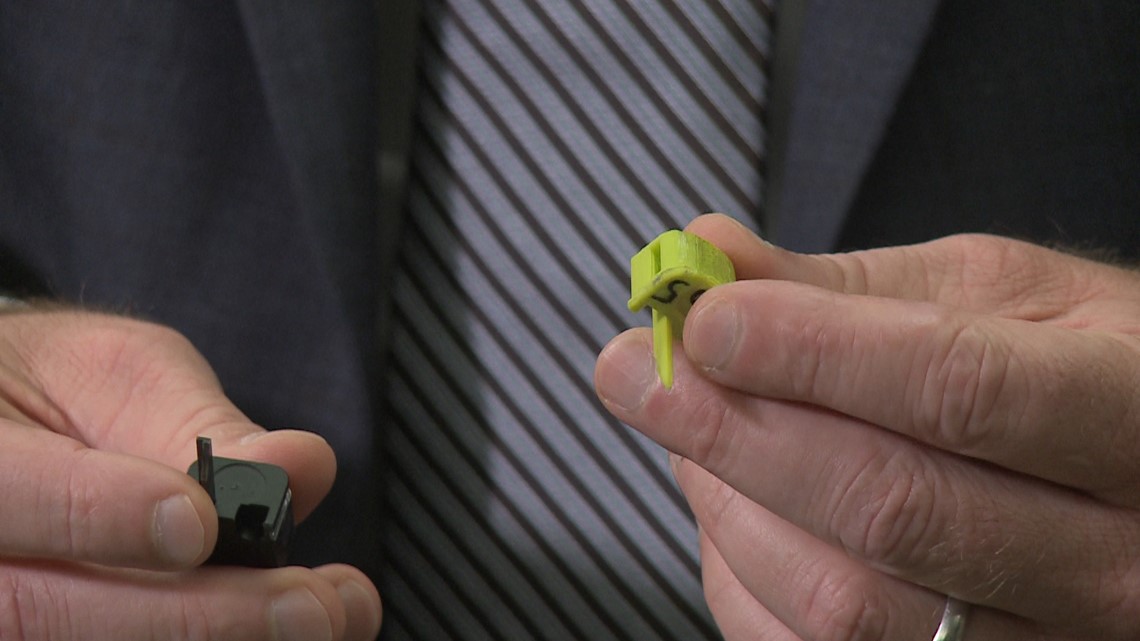
Legally, a “switch” is the common term for an auto sear or conversion device. It’s the small piece of metal or polymer, often resembling a selector switch, that modifies the firearm’s fire control group. The law isn’t limited to finished, functional devices. The legal interpretation by the ATF includes “any combination of parts” designed and intended for converting a weapon to full-auto. This means even possessing certain components or 3D printer files (like those for a “Glock 17 auto sear” or “Glock 19 switch”) with the intent to manufacture can be construed as constructive possession. It applies to all Glock models, from the subcompact Glock 26 to the full-size Glock 34. For legal, performance-enhancing modifications, Glockselectfire offers a range of aftermarket parts and triggers that keep you well within the law.
The Enforcement Reality: ATF Priority and Prosecution
Glock switches are a top-tier priority for the ATF and Texas law enforcement task forces. These devices are frequently associated with criminal enterprises, and their proliferation has led to aggressive crackdowns. Prosecutors do not need to prove you fired the weapon; mere possession is the charge. Cases are built from social media posts, shipping records, and forensic analysis of the device itself. If you’re looking for the tactile feel of a controlled, rapid trigger reset without crossing the line, invest in a quality aftermarket trigger job. A polished connector and a reduced-power safety plunger spring from a reputable shop like Glockselectfire can significantly improve performance legally. Browse our full catalog of compliant upgrades.
Legal Alternatives for Enhanced Performance
You can achieve a vastly improved shooting experience without violating federal law. Focus on legal modifications that enhance rate of *aimed* fire, not uncontrolled automatic fire. Start with a professional-grade drop-in trigger kit. Pair that with a ported or threaded barrel from our barrels category to manage muzzle rise. Adding a sturdy frame-mounted compensator and training with magazine extensions for faster reloads will do more for your practical speed than an illegal switch ever could. These are the tools serious shooters use to gain a measurable edge in competition or defensive training, all while maintaining full compliance. That’s the smart path forward.
Where are Glock switches legal?
Glock switches, as unregistered machine gun conversion devices, are not legal in any state under federal law. The only legal way to possess a machine gun, including a switched Glock, is if it was registered in the National Firearms Registry before May 19, 1986. These “transferable” machine guns are extraordinarily rare and expensive, often costing tens of thousands of dollars, and are not something the average citizen can acquire.
Can I own a Glock switch if I don’t install it?
No. Constructive possession is a key legal doctrine here. Merely owning the device, even if it’s in a drawer and not in a firearm, is considered possession of an unregistered machine gun under federal law. The intent to use it is often inferred from the possession itself. There is no “collector” or “inert” exemption for these devices unless they have been formally demilled and classified as such by the ATF.
What happens if I’m caught with a Glock switch in Texas?
You will face federal felony charges for possession of an unregistered machine gun under the National Firearms Act. This carries a mandatory minimum sentence of up to 10 years in federal prison and fines up to $250,000. You will also likely face parallel state felony charges under Texas Penal Code § 46.05. Your firearms will be confiscated, and you will lose your right to own any firearm in the future.
Your commitment to the shooting sports or personal defense demands responsible ownership. The risks of illegal conversion devices far outweigh any perceived benefit. For performance you can count on that keeps you on the right side of the law, explore the vetted, high-quality components at Glockselectfire. Browse our Glock switches collection of legal performance upgrades and build a superior, reliable firearm the right way.
Last updated: March 27, 2026
The Legal Reality of Glock Switches: What You Need to Know

The Legal Reality of Glock Switches: What You Need to Know
As of March 2026, a Glock switch—a small metal or polymer device that converts a semi-automatic Glock pistol into a fully automatic machine gun—is federally classified as a machine gun under the National Firearms Act (NFA). Possession of one without the proper tax stamp, registration, and approval from the Bureau of Alcohol, Tobacco, Firearms and Explosives (ATF) is a felony punishable by up to 10 years in prison and a $250,000 fine. This isn’t a gray area; it’s black-letter law under 26 U.S.C. § 5845(b).
Federal Law: The NFA and Machine Gun Definition
The legal foundation is the National Firearms Act of 1934 and the subsequent Gun Control Act of 1968. The ATF’s definition is explicit: any part or combination of parts designed and intended solely and exclusively to convert a weapon into a machine gun is itself a machine gun. This means a Glock switch, whether it’s a “Giggle Switch,” an “Auto Sear,” or a “Selector Switch,” is treated with the same severity as a fully assembled M16. The moment you drill the third pin hole in your Glock frame to accommodate a switch, you’ve manufactured an NFA item. Even possession of the component part alone, without it being installed, constitutes illegal possession of a machine gun if you also possess the host firearm it’s designed for. There is no “intent” loophole; constructive possession is a real and prosecuted charge.
State Laws: A Patchwork of Additional Restrictions
While federal law provides the baseline, state laws can be far more restrictive. In states like California, New York, New Jersey, Illinois, and Hawaii, state statutes explicitly ban the possession, manufacture, or transfer of any machine gun or part thereof, with no provision for civilian ownership under the NFA. This means even if you theoretically possessed a federally registered switch (an extreme rarity for civilians post-1986), you would still be committing a state felony in those jurisdictions. Other states may align with federal NFA rules but add their own registration requirements. Before even considering the legal pathway, you must consult your specific state’s penal code. Ignorance of state law is not a defense.
The Legal Pathway: Can You Own One Legally?
For the average civilian, the legal pathway to owning a functional Glock switch is effectively closed. The Firearm Owners’ Protection Act of 1986 froze the registry for new-transferable machine guns to those registered before May 19, 1986. A pre-1986 registered Glock 18 or a registered drop-in auto sear (RDIAS) for an AR-15 can legally transfer, but these are collector’s items costing $30,000 to $50,000. A newly manufactured Glock switch cannot be added to the registry for civilian transfer. The only legal avenues are for qualified Special Occupational Taxpayers (SOTs) like manufacturers, dealers, and exporters under a Federal Firearms License (FFL), or for specific government and law enforcement purchases. For the civilian shooter looking for enhanced performance, your only legal options are aftermarket components that do not alter the rate of fire, available from reputable dealers like Glockselectfire.
Legal Alternatives for Enhanced Performance
Since a functional auto sear is off the table, focus on legal modifications that improve controllability and speed within a semi-automatic framework. A quality compensator, like those for the Glock 19 or Glock 17, can significantly reduce muzzle rise for faster follow-up shots. Upgraded triggers from brands like Agency Arms or Johnny Glock, available in our Glock Parts category, can provide a cleaner, shorter reset. Pair this with a high-capacity magazine and dedicated training, and you can achieve a high level of practical performance without violating federal law. These are the tools serious shooters use to gain a real edge.
The Consequences of Illegal Possession
The penalties are severe and life-altering. A federal felony conviction for possession of an unregistered machine gun carries the prison time and fines mentioned, plus the permanent loss of your right to own any firearms. The ATF and DOJ have significantly increased prosecution of these cases, often using federal resources to target illegal switches. They are not interested in “just a part.” Furthermore, if the illegal switch is used in connection with another crime, sentences can be stacked consecutively. It’s a risk that has zero upside. At Glockselectfire, we provide only accessories and components that comply with all federal and state regulations, because our customers’ safety and freedom are paramount.
Is it legal to buy a Glock switch if I don’t own a Glock?
No. Under the ATF’s interpretation of “constructive possession,” if you possess a part designed exclusively to convert a firearm into a machine gun, and you also possess a firearm capable of accepting that part, you can be charged. Even without the host firearm, purchasing the part alone can be construed as intent to manufacture an NFA item, and the transaction itself would be illegal.
What about “Glock switch” videos or blueprints online?
Viewing videos is not illegal, but manufacturing your own switch from blueprints or a 3D printer file is. The act of manufacturing—milling, drilling, or printing the component—is the creation of an unregistered NFA item. The ATF has successfully prosecuted individuals for manufacturing machine guns using 3D printers and CNC mills based on online plans. Digital files are also increasingly targeted.
Yes, but extreme caution is required. Some inert training aids or dummy replicas exist for military and law enforcement demonstration. However, if the device is capable of being readily converted to function—or if it’s marketed in a way that suggests functional use—the ATF may still classify it as a machine gun. It is not a product category we engage in. For demonstrable, legal performance gains, invest in a quality aftermarket trigger or slide instead.
The bottom line is clear: pursuing a functional Glock switch is a direct path to felony charges. For shooters dedicated to improving their skills and equipment, the legal market offers exceptional, high-performance alternatives that keep you on the range and out of court. We support responsible ownership and provide the parts that help you shoot better, legally. Browse our glock switches collection for compliant accessories and upgrades designed for the serious shooter.
Last updated: March 27, 2026
What Is the Glock Switch Ban?
What Is the Glock Switch Ban?
On December 27, 2021, the ATF published Final Rule 2021R-08F, redefining “machinegun” to include any device “designed, made, and intended” to convert a semi-automatic firearm into a machinegun. This rule, effective 120 days later, directly targeted Glock switches, auto sears, and similar conversion devices, regardless of whether they were made of plastic, metal, or polymer. Overnight, possession of these items became a federal felony without proper registration under the National Firearms Act.
The Legal Definition of a “Machinegun” Now Includes Switches
The core of the ban hinges on a reinterpretation of the statutory definition. Prior to 2021, the legal landscape was complex, with some arguing that a standalone, unserialized switch wasn’t a “machinegun” until installed. The ATF’s new rule closed that perceived loophole. The rule states that any part or combination of parts designed and intended solely for use in converting a firearm to fire automatically is itself a machinegun. This means a Glock switch in your pocket, even if not attached to a pistol, is considered an NFA firearm. The penalty for possession of an unregistered machinegun is up to 10 years in federal prison and a $250,000 fine. This applies to all variants, whether for a Gen 3 Glock 17 or a newer Gen 5 Glock 19.
What This Means for Current Owners and the Market
For individuals who already possessed these devices before the rule’s effective date (April 26, 2022), the ATF provided a limited amnesty period to register them on a Form 1 “Application to Make and Register a Firearm.” This process required fingerprinting, a background check, and a $200 tax. That window is long closed. Today, the manufacture, sale, or transfer of new Glock switches to civilians is prohibited. The market has been driven almost entirely underground or towards manufacturers who have secured the proper Federal Firearms License (FFL) with a Special Occupational Tax (SOT) to produce and transfer registered dealer samples to qualified entities like law enforcement or military. Sites like Glockselectfire now cater exclusively to this professional, licensed market.

State Laws vs. Federal Law: A Double Jeopardy
The federal ban is just the baseline. Numerous states have enacted their own, often more severe, laws regarding machinegun conversion devices. States like California, New York, Illinois, and Washington have explicit statutes banning possession, often with mandatory minimum sentences that stack on top of potential federal charges. In these jurisdictions, you’re not just facing the ATF; you’re facing state prosecutors. For example, Illinois’ law categorizes a switch as a “machine gun” itself, carrying a Class 2 felony charge. It’s critical to understand that compliance with federal law does not guarantee compliance with state law, and vice versa. This patchwork of regulations makes legal ownership for civilians virtually impossible outside of very specific, pre-1986 transferable machineguns.
Enforcement and the Rise of “Ghost Guns”
Enforcement of the switch ban has become a top priority for the ATF and local law enforcement, frequently cited in press releases about arrests. The proliferation of cheap, 3D-printed auto sears and the sale of components on clandestine parts of the internet has blurred the lines. The ATF takes the position that a 3D-printed plastic switch, even a single-use one, meets the definition of a machinegun. Furthermore, the rule impacts “privately made firearms” (PMFs), or “ghost guns.” Installing a switch on a polymer80 frame or other unserialized pistol compounds federal violations, potentially adding charges for possession of an unregistered firearm and an unregistered machinegun. The legal risk is multiplicative.

Can I legally own a Glock switch if I have a concealed carry permit?
No. A state-issued concealed carry permit has no bearing on federal National Firearms Act (NFA) regulations. A switch is classified as a machinegun. To possess one legally, it must have been registered during the 2022 amnesty period or be a pre-1986 transferable registered machinegun—an extreme rarity for a Glock platform. Your CCW does not authorize NFA items.
What if I manufactured my own switch before the ban?
If you manufactured it before April 26, 2022, you were required to register it on an ATF Form 1 during the amnesty period to retain legal possession. If you did not, it is now an unregistered machinegun under federal law, and possession is a felony. The “I made it myself” defense is not valid under the current rule.
Are there any legal alternatives to a full-auto switch?
For civilian shooters, yes. Devices like the Fostech Echo trigger or binary triggers (where one pull fires a round and release fires another) are engineered to remain semi-automatic under the law. They are distinct from a switch or auto sear. However, their legality varies by state. They are not considered machineguns, but they are also not the same as the full-auto conversion devices sold to licensed entities by vendors like Glockselectfire.
Browse our glock switches collection
Last updated: March 27, 2026
What Are Glock Switches?
What Are Glock Switches?
You’ve seen the videos: a Glock pistol firing at a cyclic rate rivaling a submachine gun. That’s not a modified trigger or a Hollywood prop. That’s a Glock switch, a small, aftermarket component that fundamentally alters the firearm’s function from semi-automatic to fully automatic. As an industry professional, I’ve handled the real deal, and the engineering behind these tiny devices is both simple and profound.
The Core Mechanism: Converting a Glock
A Glock switch is technically a sear, often called an auto sear or selector switch. It replaces or interfaces with the factory rear plate on the slide. The standard Glock fire control system relies on the trigger bar disengaging from the striker after each shot, requiring the trigger to be reset. A switch introduces a secondary, spring-loaded sear that holds the trigger bar in the disengaged (fired) position. When installed, the slide’s reciprocating action automatically resets this secondary sear, allowing the striker to fall again the instant the slide returns to battery. This creates an open-bolt-like firing cycle within a closed-bolt pistol. The result is a rate of fire between 1,200 and 1,500 rounds per minute, emptying a standard 17-round magazine in under a second. It’s a mechanical override, not an electronic one.

Understanding the internal mechanics is key. This isn’t a simple spring change; it’s a full fire control group modification.
Common Types and Formats
In the market, you’ll primarily encounter two physical formats. The first is the classic “switch” or “button” style, which protrudes from the rear of the slide and must be physically flipped up or down to engage the auto-sear. The second is the “selector” style, which mimics the look of an AR-15 safety selector, often mounted on the left side of the frame near the slide release. Internally, they achieve the same goal. Quality varies wildly from crude 3D-printed zinc alloy casts to precisely machined steel units. A proper switch for a Glock 17, 19, or 26 must be hardened to withstand the intense, rapid hammering of the sear surfaces. The cheap ones fail—catastrophically. The ones we vet at Glockselectfire are built to mil-spec tolerances.
Legal Status: The Critical 1986 Law
This is non-negotiable and where most people get into serious trouble. Under the National Firearms Act (NFA) of 1934 and the Firearm Owners’ Protection Act of 1986, a machine gun is defined as any weapon which shoots, is designed to shoot, or can be readily restored to shoot, automatically more than one shot by a single function of the trigger. A Glock switch meets this definition. It is considered a machine gun in and of itself, regardless of whether it’s installed on a host firearm. Mere possession, without the proper federal licensing and tax stamp, is a felony punishable by up to 10 years in prison per count. This isn’t a state-level gray area; it’s federal law enforced by the ATF.

The legal framework is absolute. Ownership requires specific, rare federal licenses (SOT).
Function, Risks, and Reality
Beyond legality, let’s talk function and safety. A switched Glock is nearly uncontrollable in sustained fire. The muzzle climbs violently, making accurate fire past the first round almost impossible for anyone without extensive training. The stress on the pistol’s frame, slide, and locking block is immense, leading to accelerated wear and potential catastrophic failure with prolonged use. Furthermore, the aftermarket switch itself is a potential point of mechanical failure. A poorly made sear can cause a runaway gun—a “full auto” that won’t stop firing until the magazine is empty or the gun malfunctions. This isn’t a toy or a practical upgrade; it’s a specialized conversion that turns a defensive tool into a highly specialized, and legally restricted, automatic weapon.
FAQs: Glock Switches Explained
What is a Glock switch?
A Glock switch is an aftermarket auto sear device that converts a semi-automatic Glock pistol into a fully automatic machine gun. It mechanically alters the fire control group to hold the trigger in the fired position, allowing the slide’s action to cycle the striker continuously. Under federal law, it is legally defined as a machine gun itself.
What is the Glock switch ban?
There is no specific “Glock switch ban”; they are already illegal under longstanding federal law. The term often refers to increased enforcement efforts and public awareness campaigns by the ATF and DOJ targeting the proliferation of these devices, many of which are imported or sold online as “solvent traps” or “auto key cards” to circumvent detection.
What is the Glock Switch Act?
There is no federal legislation called the “Glock Switch Act.” The legal authority governing these devices is the National Firearms Act (NFA) of 1934 and the Gun Control Act (GCA) of 1968. Some proposed state-level bills may use similar names to enhance penalties, but federal NFA regulation is the primary and controlling law.
Browse our glock switches collection
Last updated: March 27, 2026
What is a Switch for a Glock? The Definitive Technical Breakdown

What is a Switch for a Glock? The Definitive Technical Breakdown
A Glock switch, properly termed a selector switch or auto-sear, is a small, precisely machined component that replaces the factory rear plate on a Glock pistol. When installed, it mechanically alters the firearm’s fire control group to enable fully automatic fire. This isn’t a modification for beginners; it requires a specific host frame, compatible components, and a deep understanding of the National Firearms Act (NFA). At Glockselectfire, we provide the components for those who have navigated the legal process to own a registered machine gun.
The Mechanical Function: How a Glock Auto-Sear Works
Unlike a drop-in binary trigger, a true Glock switch functions as an external sear. It sits in the rear cavity of the slide, interacting with the trigger bar and cruciform. In semi-auto mode, the disconnector resets the trigger bar after each shot. The switch, when engaged, physically blocks the disconnector from functioning. This allows the trigger bar to remain in the “fire” position as the slide cycles, causing the striker to release the moment the slide returns to battery. The result is uncontrolled automatic fire until the trigger is released or the magazine is empty. This is why the host firearm must be a pre-1986 registered receiver or a newly manufactured, properly registered machine gun frame to be legal.
Compatibility and Host Platform Requirements
Not every Glock can accept a switch. The most compatible platforms are Gen 3 models, specifically the Glock 17 and Glock 19 in 9mm. The reason is the design of the rear rail and the specific geometry of the trigger mechanism housing. Later generations have subtle changes that often require modification. You’ll need a full-auto compatible trigger mechanism housing (often denoted by a “FA” stamp) and a corresponding auto-sear spring. Attempting to install a switch on an incompatible or unregistered frame is not only mechanically unsound but a serious federal felony. For builders with the proper paperwork, our Glock Switches category lists components compatible with various generations.
Legal Status: NFA and the Critical 1986 Cutoff
Under U.S. federal law, a Glock switch is considered a machine gun as defined by the National Firearms Act of 1934 and the Firearm Owners’ Protection Act of 1986. This means the device itself, and the firearm it’s installed in, is strictly regulated. It is illegal to manufacture or possess a machine gun for civilian ownership that was not registered with the ATF prior to May 19, 1986. The only legal path for new possession is through a Class 3 SOT (Special Occupational Taxpayer) for demonstration, law enforcement, or military sales, or through the transfer of a pre-1986 registered receiver. We only provide components to verified, licensed entities in compliance with all regulations.
Product Considerations and Sourcing
Quality matters immensely. A poorly machined switch can lead to out-of-battery detonations, runaway full-auto fire, or catastrophic failure. Look for components made from hardened tool steel or billet aluminum, not cheap MIM or cast parts. The fit should be precise with no play. At Glockselectfire, we vet our suppliers for material quality and dimensional accuracy. For those assembling a legal post-sample or building on a registered frame, pairing a quality switch like those in our full catalog with a heavy-duty recoil spring assembly and a dedicated full-auto rated lower parts kit is essential for reliability and safety.
Frequently Asked Questions
What is a switch for glock?
A Glock switch is a selector switch or auto-sear, a small metal component that replaces the rear plate on a Glock pistol. When installed on a legally registered host firearm, it mechanically converts the pistol from semi-automatic to fully automatic fire. It is regulated as a machine gun under the National Firearms Act.
What is a switch for a glock pistol?
It is the same device: an auto-sear for a Glock pistol. The term “switch” is common slang derived from the selector lever that toggles between safe, semi, and auto positions on compatible models. It is not a simple electronic device but a precision mechanical sear that alters the firearm’s internal function.
What does a switch for glock look like?
A typical Glock switch is a small, rectangular block of metal, often anodized black or raw steel, approximately 1 inch long. It has a selector lever on one side and a pin or protrusion that interfaces with the trigger mechanism. It fits flush into the rear of the Glock’s slide where the standard rear cover plate is removed.
For qualified professionals and licensed entities, having access to properly engineered components is non-negotiable. Browse our glock switches collection to see our selection of machined auto-sears, compatible parts, and accessories designed for durability and precise function.
Last updated: March 27, 2026